

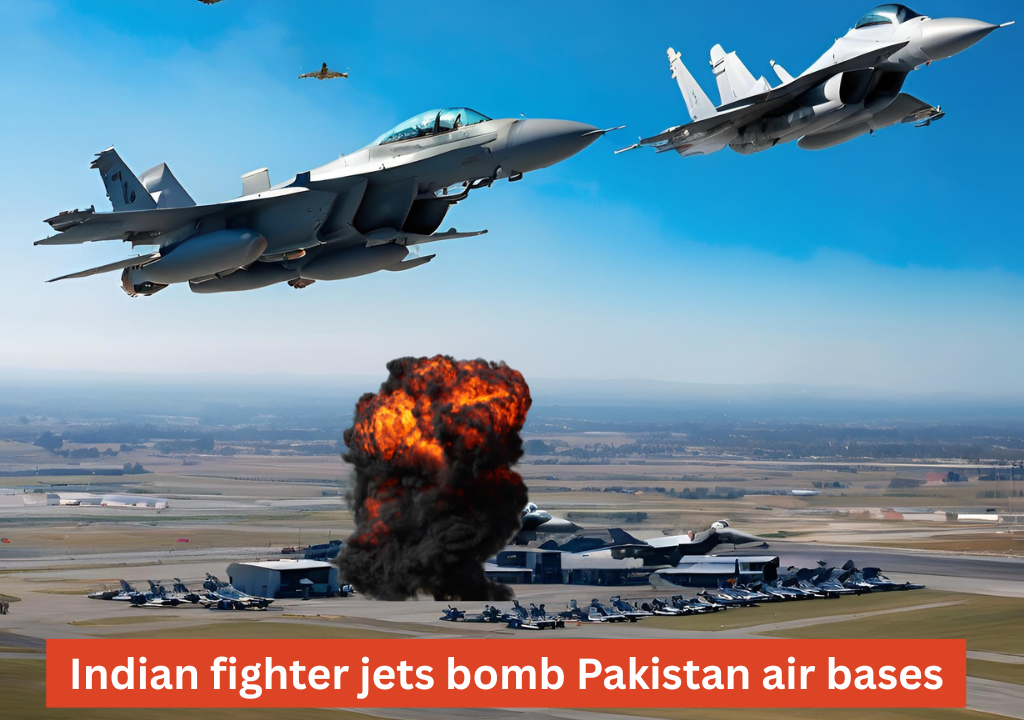
Indian fighter jets bomb Pakistan air bases in a swift and calibrated counteroffensive following Pakistan’s drone and missile attacks across India’s western sector. The Indian Air Force (IAF) launched precision airstrikes on key Pakistan Air Force (PAF) installations at Rafiqui, Murid, Chaklala, and Rahim Yar Khan. These strikes were aimed at neutralizing Pakistan’s offensive infrastructure while ensuring minimum collateral damage. Demonstrating remarkable restraint and strategic clarity, India’s action reinforced its commitment to defense without unnecessary escalation. As tensions rise, the operation underscores India’s readiness to defend its sovereignty with precision and professionalism.
Indian Fighter Jets Bomb Pakistan Air Bases in Strategic Retaliation
In response to unprovoked Pakistani drone attacks on Indian civilian and military areas, Indian fighter jets bombed Pakistan air bases in a precise and calculated move. These bases were used to launch hostile UAVs and munitions against India. The Indian Air Force’s retaliation struck critical military zones with advanced precision-guided weapons, showing India’s technological and operational superiority.
Why Did India Launch These Strikes?
Pakistan used unmanned combat aerial vehicles (UCAVs), long-range missiles, and fighter aircraft to target Indian military infrastructure and civilian areas. These provocations led to casualties and equipment damage at Udhampur, Pathankot, Adampur, and Bhuj.
In response, India launched targeted airstrikes against PAF facilities in:
- Rafiqui
- Murid
- Chaklala
- Rahim Yar Khan
- Sukkur
- Chunia
- Pasrur radar station
- Sialkot aviation base
These air bases were neutralized using air-launched precision munitions, effectively halting Pakistan’s ability to continue its aggression.

Precision with Minimum Collateral Damage
Wing Commander Vyomika Singh emphasized that Indian fighter jets bomb Pakistan air bases with utmost care, selecting only verified military targets. The objectives included:
- Command and control centers
- Radar and surveillance sites
- Weapon storage facilities
- Technical infrastructure
The Indian Air Force ensured that no civilian installations were harmed. Each strike demonstrated India’s commitment to international conflict protocols, even during high-stakes retaliation.
Operation Sindoor: Precision Strikes Across Pakistan and PoK
As part of its calibrated military response, India launched Operation Sindoor, a series of precision strikes that targeted nine terror hubs across Pakistan and Pakistan-occupied Kashmir (PoK). This decisive action was a direct response to the April 22 terror attack in Pahalgam, which resulted in multiple civilian casualties and heightened national security concerns. The attack was widely attributed to Pakistan-based terror outfits, notably Jaish-e-Mohammed. Under this operation, Indian fighter jets carried out coordinated airstrikes on camps, launchpads, and control nodes used by these groups, reinforcing India’s resolve to dismantle cross-border terrorism at its roots. Military sources confirmed that all targets were carefully identified and verified, ensuring that collateral damage was minimal, and operational success was achieved with precision.
Pakistan’s Misinformation Campaign Debunked
Pakistan attempted to spread false narratives by claiming they had destroyed:
- India’s S-400 air defense system at Adampur
- Airfields at Suratgarh and Sirsa
- BrahMos base at Nagrota
- Ammunition depot at Chandigarh
However, Wing Commander Singh presented timestamped satellite images proving these claims baseless. The misinformation campaign was described as malicious and strategically misleading, aimed at manipulating global opinion.
India’s Commitment to Non-Escalation
Despite Pakistan’s provocative actions, India reiterated its stance on non-escalation, provided the intent is reciprocated. Colonel Sofiya Qureshi confirmed that India would not initiate further conflict but remains militarily ready.
She noted the forward movement of Pakistani troops, indicating offensive preparations. In response, Indian forces remain in a high state of operational readiness, capable of defending the nation’s interests at all levels.
Global Reaction and Strategic Impact
Military analysts worldwide noted how Indian fighter jets bomb Pakistan air bases with unmatched precision. The strikes mark a turning point in South Asian defense dynamics, where India’s measured but firm military posture set a new precedent.
India’s actions are being seen as a deterrent against future cross-border aggression, especially involving civilian harm or strategic assets.
Conclusion
The decision to bomb Pakistan air bases was a strategic necessity, not an act of escalation. By maintaining precision, clarity, and control, India showcased its ability to defend sovereignty without breaching humanitarian protocols.
The operation delivered a clear message: India will not tolerate threats to its civilian population or military assets, and any such acts will be met with a swift and calibrated response—just as the world saw when Indian fighter jets bombed Pakistan air bases with exceptional precision.