

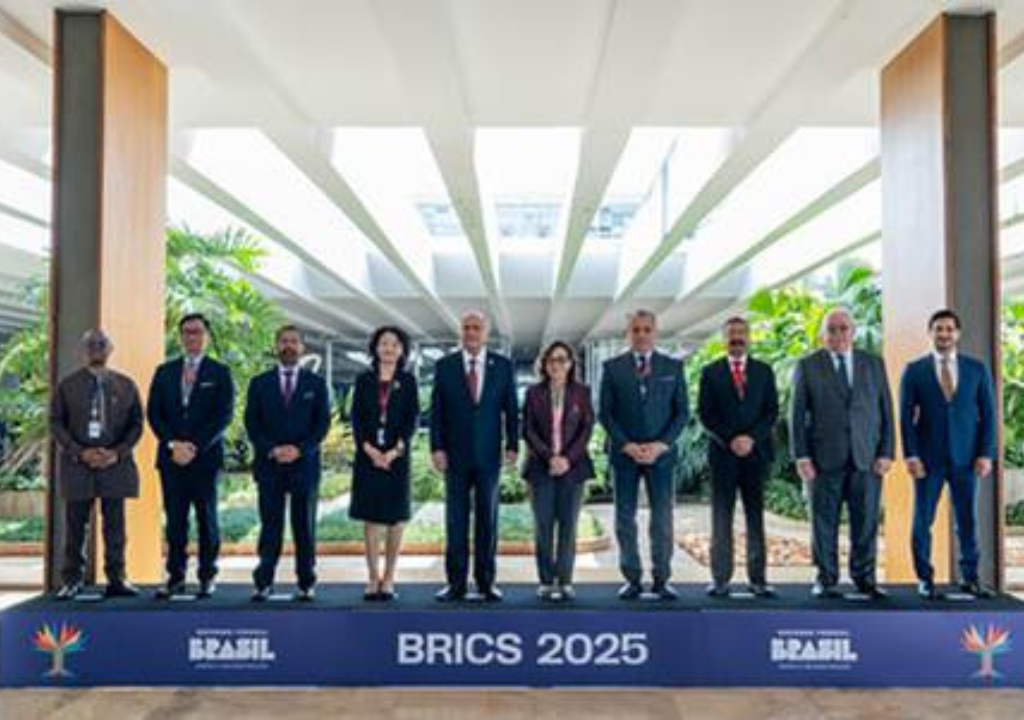
India made a significant policy pitch at the 15th BRICS Trade Ministers Meeting 2025, hosted by Brazil, calling for the removal of export controls among BRICS nations and deeper collaboration on digital transformation, WTO reforms, and climate-resilient trade frameworks. With the theme “Strengthening Global South Cooperation for More Inclusive and Sustainable Governance”, the meeting marked a turning point in reshaping trade partnerships among emerging economies.
The gathering brought together trade leaders and policymakers from Brazil, Russia, India, China, South Africa, and new member Indonesia, who officially joined BRICS in 2025. The outcomes not only reflect India’s growing role in global economic governance but also set the stage for its BRICS Presidency in 2026.
India Opposes Export Controls Within BRICS
Delivering India’s national statement, Union Commerce and Industry Minister Piyush Goyal, through his representative Shri Yashvir Singh, made it clear: BRICS must not erect trade barriers among its members.
“Export controls among BRICS countries only weaken the trust and integration we seek to build. Cooperation, not restriction, is the way forward,” the statement emphasized.
India urged all member nations to dismantle any intra-BRICS export restrictions, particularly those that affect critical supply chains and strategic sectors such as food, energy, and pharmaceuticals. The focus was on promoting mutual support, especially in times of global volatility.
Links Suggested: Rising North East Investors Summit 2025 Highlights New India Growth
Joint Declaration Endorsed: Key Agreements
A major outcome of the meeting was the endorsement of a Joint Declaration, accompanied by three annexures:
- BRICS Declaration on WTO Reform and Strengthening of Multilateral Trading System
- BRICS Data Economy Governance Understanding
- BRICS Trade and Sustainable Development Framework
These documents reaffirm BRICS’ collective commitment to equitable, transparent, and rules-based trade, with a specific focus on addressing the needs of the Global South.
Notably, the declaration criticized unilateral climate-related trade measures, stating that such policies should not become tools for disguised protectionism or discriminatory practices.
India’s Vision for WTO Reform: “30 for 30”
India reiterated its strong position on WTO reform, demanding meaningful outcomes for developing countries. It revived its “30 for 30” proposal—a call for 30 key reforms to mark the WTO’s 30th anniversary in 2025.
Among the most critical issues raised was the Permanent Solution to Public Stockholding (PSH) for food security—an issue that disproportionately affects developing countries’ ability to support vulnerable populations during crises.
India’s stance stressed that WTO reform must go beyond institutional reconfiguration to address longstanding inequities.
Climate Responsibility: Mission LiFE and ESTs
India used the BRICS platform to push for a just and equitable climate responsibility framework, aligned with its global initiative Mission LiFE (Lifestyle for Environment).
The Indian statement emphasized:
- Mindful consumption and circular economy practices
- The concessional transfer of Environmentally Sound Technologies (ESTs) to developing nations
- The need for financial assistance mechanisms to support climate-resilient trade
India argued that sustainable trade practices must be rooted in shared but differentiated responsibilities, rather than allowing developed countries to dictate terms through carbon border taxes or climate-based trade barriers.
Links Suggested: Bangladesh Political Crisis 2025: Army Chief Warns Yunus
India Welcomes Indonesia to BRICS
India formally welcomed Indonesia as a full BRICS member in 2025, noting its strategic importance in promoting South-South cooperation. The inclusion is expected to bring greater cohesion within the grouping, especially in coordinating Indo-Pacific trade, maritime security, and regional supply chain resilience.
Digital Public Infrastructure (DPI): The Indian Model Gains Global Traction
India’s Digital Public Infrastructure (DPI) model—anchored by initiatives such as Digital India, India Stack, and IndiaAI—received strong acknowledgment in the BRICS Data Economy Governance Understanding.
India emphasized that DPI is not only a tool for digital transformation but a democratic enabler that promotes:
- Financial inclusion
- Accessible e-governance
- Transparent public services
- Cybersecurity and AI readiness
Through its participation in Global Partnership on AI (GPAI) and its G20 Digital Economy Working Group leadership, India pledged continued collaboration with BRICS partners to develop open-source, interoperable digital infrastructure that ensures no citizen is left behind.
BRICS Trade and Sustainable Development Framework
In a nod to India’s cultural ethos of sustainability, the framework promotes:
- Sustainable resource utilization
- Support for MSMEs adopting green practices
- Biodiversity conservation through trade policies
- Incentives for clean-tech adoption
India advocated aligning trade frameworks with UN SDG targets, encouraging BRICS to act as a collective voice for sustainable economic governance.
Call for Decentralized Trade Architecture
India’s statement strongly pushed for a reform of the global trade architecture, urging BRICS to build a decentralized, multipolar trade framework that:
- Prioritizes the needs of developing nations
- Supports regional value chains
- Counters the dominance of unilateral trade rules
The vision, according to India, should be to replace fragmented trade blocks with cohesive partnerships that uphold multilateralism and equity.
India’s BRICS 2026 Presidency: What to Expect
As India prepares to take over the BRICS Presidency in 2026, observers expect a strong emphasis on:
- Technology equity through open-source DPI models
- Climate justice and EST financing
- WTO reforms centered on Global South priorities
- Collaborative semiconductor and AI frameworks
- South-South investment partnerships and startup ecosystems
India is also expected to promote greater synergy between BRICS and forums like the G20, IBSA, and Shanghai Cooperation Organisation (SCO) to coordinate development financing, debt sustainability, and food security solutions.
Conclusion
The BRICS Trade Ministers Meeting 2025 concluded with India reinforcing its role as a champion of Global South priorities, a digital governance innovator, and a reliable anchor for multilateral reform. From export liberalization within BRICS to democratizing digital infrastructure and pushing for WTO transformation, India’s proactive approach has positioned it as a driving force in reshaping equitable global trade governance.
As the world’s largest democracy prepares to take the reins of the BRICS grouping in 2026, it is clear that India’s vision for trade, tech, and sustainability is set to shape the global south’s future.